


The English proficiency test has become a commonly recognized benchmark which is being employed by educational institutions, businesses, professional boards, and immigration authorities around the world. This enables organisations to measure whether one has the necessary language competencies to cope with the demands in the learning institution or work environment. With increasing international movement expected in 2026, it will be important to select the appropriate English language test for students, professionals, and migrants.
Relying solely on a strong academic or professional record is no longer a viable strategy for international relocation. Admissions committees and corporate recruiters now implement language proficiency exams as a strict preliminary screening tool. Failing to meet their exact language criteria results in immediate disqualification, regardless of your other qualifications.
If you live and work in the UAE, you already know how competitive the market is. The Emirates act as a massive global intersection for talent. Because the bar is so high, your language certificate acts as a literal gatekeeper for your next steps. It heavily impacts three specific areas:
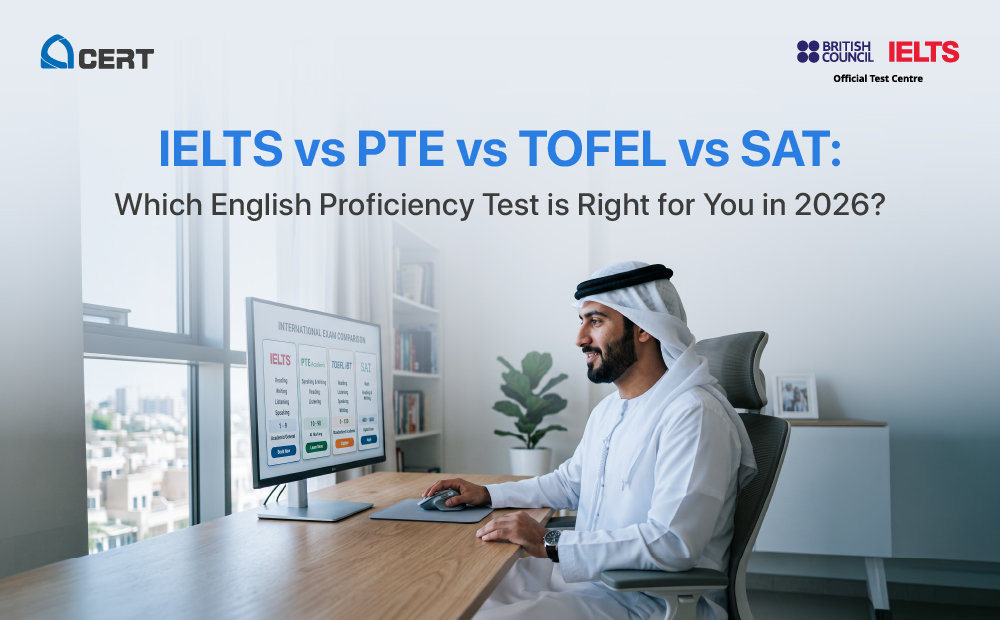
Spending months studying for the wrong exam is frustrating. To make an informed choice, you need to look objectively at what each testing system actually measures. Here is how the primary options stack up in today’s market.
The Pearson Test of English (PTE) centers entirely around automation. It is a fully computer-based exam where machine algorithms score every single section, including the speaking module. Because human examiners are removed from the loop, results come back quickly, usually within 48 hours. Candidates who feel more comfortable interacting with software rather than talking to a person typically lean toward this option.
TOEFL
The TOEFL (Test of English as a Foreign Language) is a widely accepted English proficiency test used by universities around the world. It measures your reading, listening, speaking, and writing skills in an academic setting. Depending on your location and the available options, you can take the test at an official test center or online from home. TOEFL scores are accepted by thousands of universities and are also used for some visa and professional applications, depending on the country’s requirements
A common misconception among applicants is treating the SAT as a general language proficiency test. They are completely different tools. The SAT is an academic aptitude test built for the US education system. While it features advanced reading comprehension and grammar sections, it also includes a heavy mathematics component. Universities use it to gauge overall college readiness for high school graduates, not everyday language fluency.
It is important to note that SAT scores do not typically replace IELTS or other English proficiency tests. Many universities may require both, depending on the applicant’s educational background and country of origin.
Linguaskill operates almost exclusively as a corporate evaluation tool. Linguaskill, developed by Cambridge, is commonly used by employers and organizations to assess workplace communication skills. While it offers a quick and flexible way to evaluate English proficiency, it is generally not accepted for most immigration pathways or university admissions when compared with IELTS or PTE.
To help simplify the decision-making process, the table below provides a quick comparison of the primary purpose, recognition, and speaking format of some of the most commonly used tests in 2026.
Test | Primary Purpose | Recognition | Speaking Assessment |
IELTS | Study, Migration, Work, Professional Licensing | Widely accepted globally | Face-to-face with an examiner |
PTE Academic | Study, Migration, Professional Applications | Widely accepted by many institutions and immigration authorities | Computer-recorded and AI-scored |
TOFEL | University Admissions | Accepted by 13,000+ institutions worldwide | Speaking responses recorded on a computer (no live interviewer) |
SAT | Undergraduate University Admissions (primarily US) | Accepted by universities for admissions purposes | No dedicated speaking component |
Linguaskill | Workplace and Corporate Assessment | Commonly used by employers and organisations | Computer-based |
While specialized digital platforms fit specific niches, IELTS remains the industry standard. Its level of institutional acceptance is unmatched by alternative formats.
Instead of forcing every candidate into a single generic framework, the system offers two distinct pathways tailored to specific long-term goals:
The scale of its recognition is massive, with over 12,500 organizations across 140 countries trusting its results.
One of the reasons IELTS remains a leading English proficiency test is its extensive global recognition. IELTS scores are accepted by governments, universities, employers, and professional bodies worldwide, making it suitable for a wide range of academic, migration, and career objectives. Whether you are applying for university admission, professional registration, or immigration pathways in countries such as the UK, Canada, Australia, and New Zealand, IELTS is commonly recognised as proof of English language proficiency. For candidates in the UAE, IELTS test centres offer frequent test dates and convenient access to IELTS on Computer, making it easier to book a test that aligns with your study abroad, work, or visa application timelines.
The test also provides practical flexibility. If you prefer typing your essays, the computer-delivered version is widely available. Candidates can choose IELTS on Computer, at authorized IELTS test centres across the UAE, offering greater flexibility and faster results.
For UAE residents, the logistics are highly convenient. Official centers across the Emirates run test sessions nearly every week. Whether you are calculating points for a UK, Canadian, or Australian visa, or finalizing your application for a local UAE university, the IELTS Tests framework aligns perfectly with official regulatory requirements.
The core distinction between these testing methods involves the actual psychology of the exam. Fully automated platforms require you to speak directly into a microphone, frequently in a crowded room where other candidates are doing the exact same thing simultaneously.
An algorithm then scores your voice. If you pause naturally to structure a complex thought, the software can misinterpret that silence as a lack of fluency. This often forces candidates to adopt artificial, robotic speech patterns just to satisfy the software, adding unnecessary stress to the day.
IELTS handles this process differently by using an in-person IELTS speaking test.
You sit down for a face-to-face conversation with a certified examiner. Human evaluators understand conversational context. They recognize that a brief pause to organize a sophisticated argument indicates advanced critical thinking, not a weak vocabulary. Furthermore, if you happen to miss a prompt, you can simply ask the examiner to clarify the question. That natural interaction mirrors exactly what happens in university seminars and corporate boardrooms.
Booking your exam at an IELTS Test Center in the UAE ensures your final score reflects actual interpersonal skills. Your academic and professional growth relies on practical communication. Proving you can handle the pressure and hold a natural conversation with another person provides the exact validation global institutions look for. Explore available test dates and mock test options at CERT IELTS Centres in the UAE.
Choosing the right English proficiency test depends on your goals. If your focus is university admission, professional licensing, immigration, or international career opportunities, it is important to select a test that aligns with the requirements of the institutions and authorities you are applying to. For many candidates, IELTS remains one of the most versatile and widely accepted options available today. Before booking, review the requirements of your chosen university, employer, or immigration pathway and select the test that best supports your long-term objectives.